


BBL Photorejuvenation: Sun Spots, Redness and Skin Quality
Dr. Kağan Cingöz · Dermatologist · Last reviewed: November 2026
BBL and Nd:YAG Laser Treatments
Broadband light (BBL) and the Nd:YAG laser are light-based systems used to treat vascular and pigment-related changes in the skin.
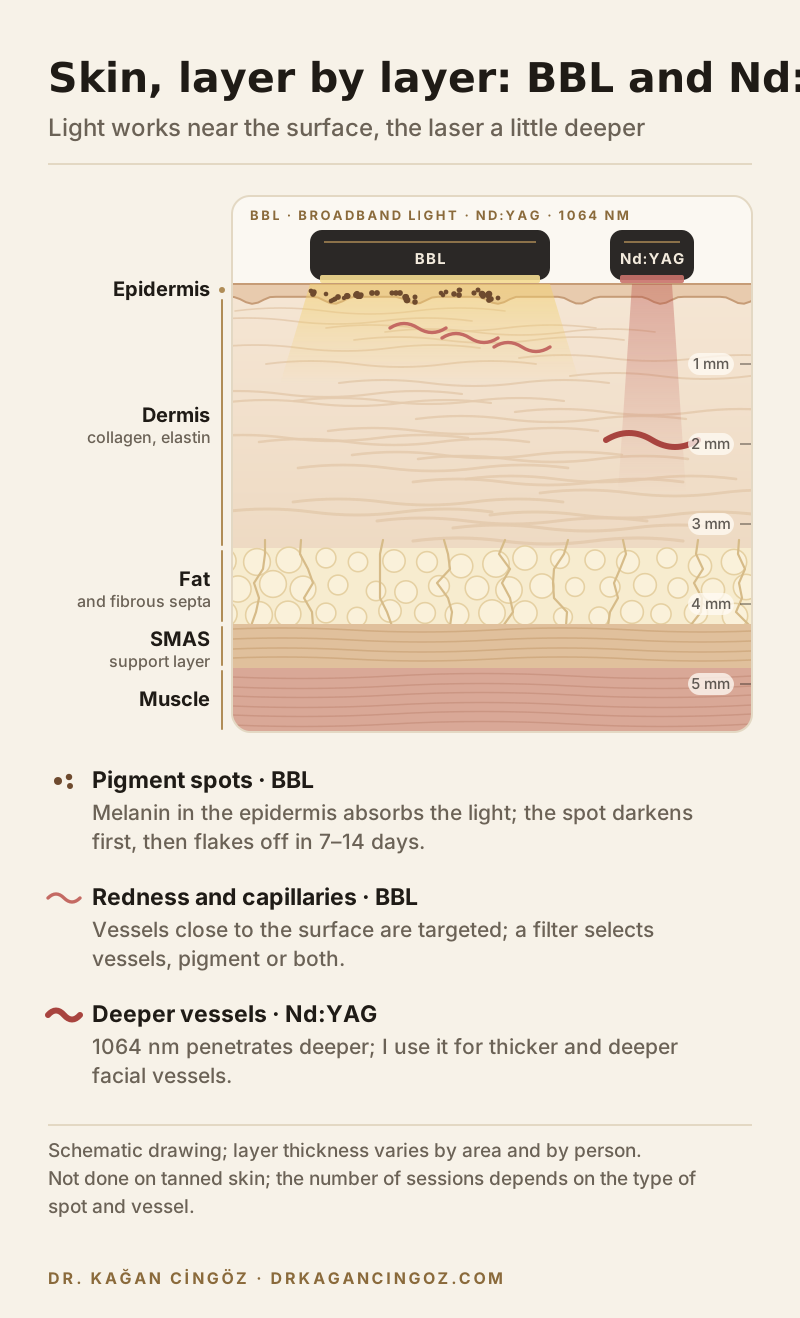
Both work on the same basic principle: the energy delivered is selectively absorbed by the target structure. In vascular lesions, the target is haemoglobin; in pigmented lesions, it is melanin. Only the target structure is heated, while the surrounding tissue is spared.
At our practice, these treatments are performed by dermatology specialist Dr. Kağan Cingöz.
What It Is Used For
Vascular lesions
Persistent redness due to rosacea
Telangiectasia (dilated superficial blood vessels)
Visible vessels on the cheeks and around the nose
Poikiloderma (redness and discolouration on the sides of the neck)
Pigmented lesions
Sun spots (solar lentigines)
Age spots
Freckles
Post-inflammatory hyperpigmentation
Skin quality
Uneven skin tone
Improving the overall appearance of the skin
Surface quality of the skin
Acne and rosacea
Reducing inflammation in active acne
The papulopustular component of rosacea
The Difference Between BBL and Nd:YAG
BBL does not produce light at a single wavelength, but across a broad range. By changing the filter, the target can be selected: vessels, pigment, or both. It is effective for superficial and mid-depth targets, and it has advantages for treating large areas and skin with more than one concern at the same time.
Nd:YAG (1064 nm) is a single-wavelength laser that reaches deeper. This has two consequences: it is effective on deeper and thicker vessels, and because it is less absorbed by melanin, it is a safer option for darker skin types.
Which one is used is decided at the consultation, based on the nature and depth of the target structure and on skin type. In some patients, both are used within the same plan for different targets.
A Separate Warning About Melasma
Melasma is a condition that appears as symmetrical dark patches on the face and behaves differently from other types of pigmentation.
Light and laser treatments are not a first-line treatment for melasma. In this condition, the heat stimulus itself can trigger melanocyte activity; as a result, the pigmentation may lighten temporarily and then come back darker (rebound). It is not unusual for the condition to end up worse than at the start after an unsuitable treatment.
The foundation of melasma treatment is topical therapy, control of triggers and meticulous sun protection. Light-based methods are considered only in selected cases, at low energy and in addition to topical treatment.
Whether the pigmentation on your face is melasma or a sun spot is clarified at the consultation, because the answer means that treatment takes a completely different course.
When Treatment Is Not Performed
Pregnancy
Active skin infection, an open wound or active severe acne in the treatment area
Use of medicines that cause sensitivity to light
A lesion of uncertain diagnosis, or a suspicious lesion, in the treatment area
Uncontrolled systemic disease
Conditions associated with photosensitivity
Patients with a history of cold sores are asked to mention this. For facial treatments, preventive antiviral treatment is given.
How Is the Treatment Performed?
Beforehand, the skin type, skin colour and target lesions are assessed. Where necessary, the nature of the lesions is clarified with dermoscopy; this is essential to be sure that a spot to be treated really is one that is suitable for treatment.
The treatment area is cleansed, protective eyewear is put on and a cooling gel is applied to the area. The handpiece is then moved systematically across the skin.
The length of the procedure depends on the area; a full-face treatment usually takes 15–30 minutes. No anaesthesia is needed.
What it feels like: during treatment there is a brief sensation similar to the snap of a rubber band. The device's cooling system noticeably reduces this sensation. The level of discomfort depends on the area and the energy setting; it is more noticeable around the nose and over areas close to the bone.
What to Expect After Treatment
For vascular lesions: after treatment, the targeted vessels may darken or disappear. Redness and mild swelling in the area lasting a few hours are normal.
For pigmented lesions: the spots darken in the first few days and take on a "coffee grounds" appearance. This is the expected course and not a sign that the treatment has gone wrong. The darkened areas form crusts and flake off within 7–14 days.
It is essential that these crusts are not picked off. Crusts that are forced off can cause permanent discolouration and scarring.
Treatment Protocol
Usually 3–5 sessions are planned; more may be needed where rosacea is pronounced
Sessions are spaced 3–4 weeks apart
The result emerges gradually as the sessions progress
To maintain the result, 1–2 maintenance sessions a year are usually planned
The number of sessions is determined at the consultation according to the type and extent of the lesions, the skin type and the response to treatment, and it is reviewed during the course of treatment.
The result is not permanent. Vascular lesions and pigmentation can develop again over time with genetic predisposition, sun exposure and ageing. Sun protection plays a decisive role in maintaining the result achieved.
Before Treatment
Sun protection is needed from 4 weeks before treatment; tanning, sunbeds and tanning products are avoided during this time.
Patients are asked to mention all the medicines they take, as some medicines cause sensitivity to light.
Current or recent use of isotretinoin should always be mentioned.
A history of cold sores should be mentioned.
Retinoids, acid-containing products and peels are stopped a few days before treatment.
Patients are asked to come without make-up and not to apply perfume or deodorant to the area.
After Treatment
Very hot showers, saunas, steam baths and intense exercise are avoided for 48 hours.
SPF 50+ sunscreen is used and reapplied during the day, both throughout the course of treatment and afterwards.
Any crusts that form are not picked, scratched or rubbed.
The recommended moisturiser is used regularly.
Retinoids, acid-containing products and peels are not used until the crusts have fully shed.
It is important to attend the follow-up appointment.
Most of the risks of this treatment can be reduced through correct assessment of skin type, appropriate energy settings and consistent sun protection, but they cannot be eliminated entirely.
How It Relates to Other Treatments
Redness, pigmentation and deterioration in skin texture are separate components; some are addressed with light-based methods, others with topical treatment.
In rosacea, light treatment targets the vascular component; topical and systemic treatments are planned separately to control papules and pustules. For pigmentation, light treatment alone is not enough: without sun protection and, where needed, topical treatment, the result cannot be maintained.
Which component takes priority, and in what order the components are addressed, is decided at the consultation.
Getting Here from Kırklareli, Lüleburgaz and Edirne
Our practice is located in central Kırklareli, at İstasyon Mahallesi Edirne Caddesi No:102/21. Because treatment requires more than one session, the intervals between sessions for patients travelling from neighbouring provinces are planned with travel arrangements in mind. Distances and travel times can be found on our directions page.
Our practice holds an International Health Tourism Certificate and also welcomes patients who come from abroad.
Frequently Asked Questions
Can treatment be done in the summer months?
It can be planned, provided the skin is not tanned and meticulous sun protection is kept up.
How many sessions are needed?
Usually 3–5 sessions, 3–4 weeks apart. The number depends on the type and extent of the lesions and on the response to treatment.
Are the results permanent?
No. Vascular lesions and pigmentation can develop again over time with predisposition, sun exposure and ageing. Sun protection and maintenance sessions are key to maintaining the result.
Is the procedure painful?
There is a brief sensation similar to the snap of a rubber band. The cooling system noticeably reduces this sensation. No anaesthesia is needed.
My spot has darkened — has something gone wrong?
No. With pigmented lesions, darkening and a "coffee grounds" appearance in the first few days are the expected course. These areas form crusts and flake off within 7–14 days. It is important not to pick off the crusts.
I have melasma — can I have this treatment?
Light and laser treatments are not a first-line treatment for melasma, and an unsuitable treatment can make the condition worse. The foundation of treatment is topical therapy and sun protection. Light-based methods are considered only in selected cases and as a supportive measure. This decision is made at the consultation.
Can I go back to work after the procedure?
Yes, the same day. There may be some redness for a few hours. If pigmentation has been treated, it is worth allowing for a temporary period of darkening and crusting lasting 7–14 days.
Who is the treatment not suitable for?
It is not performed during pregnancy, on tanned skin, in people with an active infection or an open wound in the treatment area, in people taking medicines that cause sensitivity to light, or where there is a lesion of uncertain diagnosis in the treatment area.
Appointments
For appointments and further information, you can reach us through our contact page.
The information on this page is for general information only and does not replace a medical examination. The decision to treat and the treatment plan are made after an individual examination. As with any interventional procedure, results may vary from person to person.
Last updated: November 2026 | Page editor: Dr. Kağan Cingöz

APPOINTMENTS
Consultation and treatment planning
Our practice is in central Kırklareli, Edirne Caddesi No:102/21. You can reach us by phone or WhatsApp to arrange an appointment.
Monday to Saturday, 10:00–18:15