


Ultraformer MPT HIFU: Non-Surgical Facelift in Kırklareli
Dr. Kağan Cingöz · Dermatologist · Last reviewed: November 2026
AT A GLANCE
Numbing
No anaesthesia is needed; heat and a deep prickling sensation are felt, varying by person and area.
Afterwards
There is no recovery period and daily life resumes the same day; redness, swelling and tenderness may occur.
Results
The change appears gradually; it is not permanent, and because ageing continues, re-assessment is needed.
Not suitable for
Pregnancy and breastfeeding, active infection or an open wound in the area, metal implants, pacemakers or similar devices, tendency to keloids.
General information; your plan is made at the consultation.

Non-Surgical Facelift and HIFU Treatment
With age, the skin loses elasticity, the facial contours shift downwards and the jawline loses its definition. A surgical facelift is an effective answer to these changes; for people who do not want surgery and whose sagging is mild to moderate, non-surgical options are considered.
Micro-focused ultrasound (HIFU) is a method that tightens the skin by reaching its deeper layers, without any surgical intervention.
At our practice, non-surgical facelift and Face Reformer treatments with Ultraformer MPT (HIFU) are performed by dermatology specialist Dr. Kağan Cingöz, an international trainer for the device. When skin laxity also needs work, they can be combined with Volnewmer radiofrequency in the same plan.
A Note on the Term
"Non-surgical facelift" is a widely used expression, but this method is not a facelift operation and does not deliver the result of one.
In a surgical facelift, excess skin is removed and the tissues are repositioned. With micro-focused ultrasound, no skin is removed; tightening is achieved by stimulating collagen production in the tissue. The two deliver results on a different scale, and one cannot replace the other.
What Is HIFU Technology?
HIFU is a technology that delivers micro-focused ultrasound energy to target tissues beneath the skin, creating a controlled thermal effect and, in this way, triggering the body's natural renewal process.
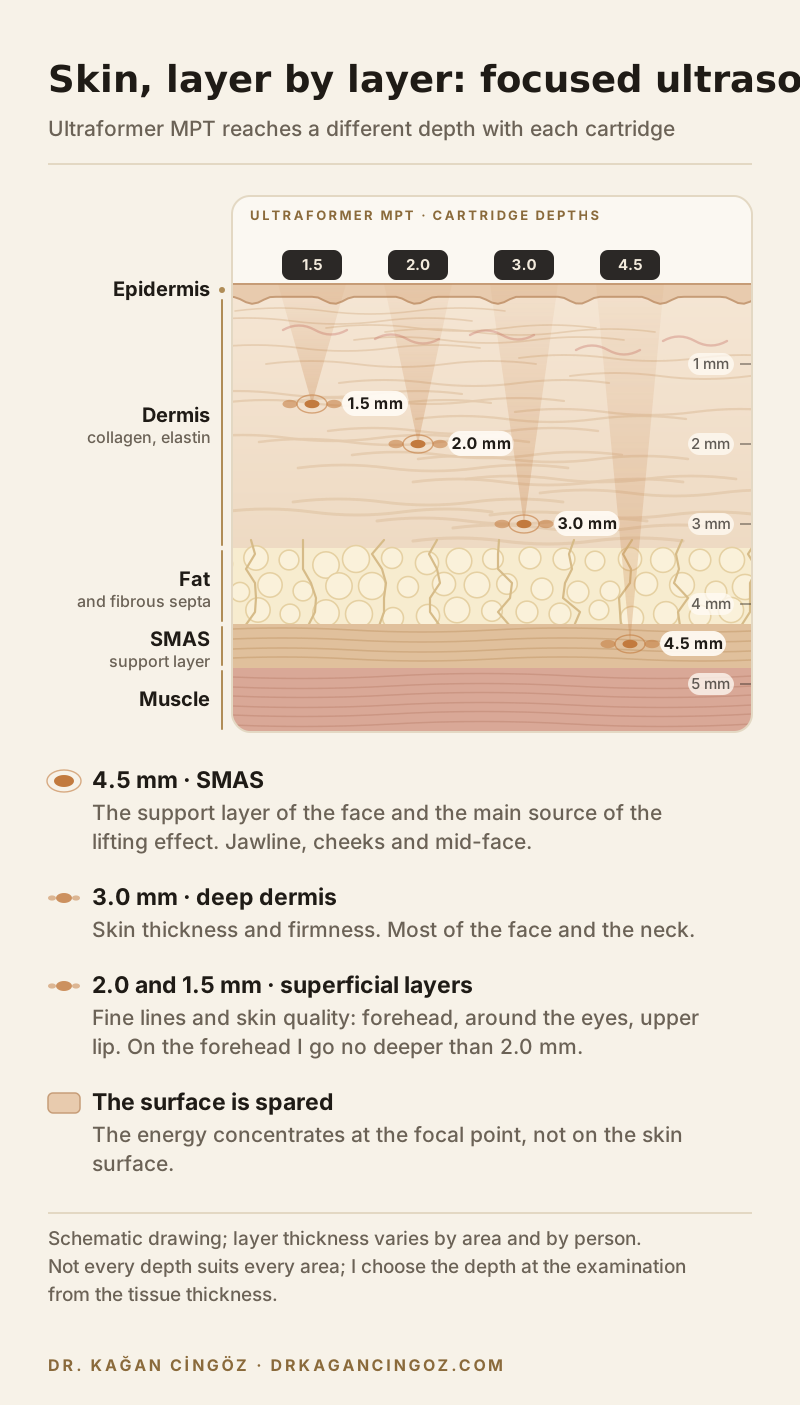
The ultrasound energy is focused on layers at defined depths without harming the skin surface. At the heat points created at these depths, existing collagen fibres contract, after which new collagen production begins.
What sets the method apart is its ability to reach, with ultrasound, the SMAS (superficial musculoaponeurotic system) layer — the same layer that is worked on in a surgical facelift. This layer forms the supporting structure of the face, and tightening at this level produces a visible lifting effect.
The Face Reformer Protocol
At our practice, non-surgical facelift treatment is not carried out as a one-size-fits-all procedure, but as a staged protocol planned for each individual.
1. Assessment and Mapping
Before treatment, the face is assessed as a whole. Three things are established at this stage:
The degree and nature of the sagging: is tissue laxity, excess skin or volume loss the main issue?
Tissue thickness: the thickness of the subcutaneous fat varies considerably from person to person, and between different areas of the same face. The energy depth is chosen on the basis of this measurement.
Regional priorities: which depth will be used in which area, and where particular caution is needed.
If treatment is carried out without this assessment, the choice of depth relies on guesswork — which can mean that the energy does not reach its target or is delivered to the wrong layer.
2. Depth Selection
The protocol is built on working not at a single depth, but in different layers according to the tissue being targeted.
6.0 mm — Deep fat layer
Targets the deep fat beneath the skin. It is used mainly on body areas (abdomen, inner arms, hips, above the knees) for volume reduction and tightening. It is not used routinely on the face; under the chin, it is considered only in selected cases where the tissue thickness is suitable.
4.5 mm — Support layer (SMAS)
Targets the load-bearing structure of the face. This layer is the main source of the lifting and firming effect. It is used on the jawline, cheeks and midface, in areas where the tissue is thick enough.
3.0 mm — Deep dermis
The layer in which skin thickness and firmness are increased. It is used over most of the face and on the neck.
2.0 mm — Superficial dermis
Reserved for areas where the skin is thin: around the eyes, the forehead, the upper lip and around the mouth. Deeper cartridges are not suitable for these areas; at 2.0 mm, the treatment targets fine lines and tissue quality.
1.5 mm — Superficial layer
The working layer closest to the skin surface. It is used for fine lines and for refining the superficial tissue.
Booster — Wide area, superficial
Serves a different purpose from the other cartridges. It does not provide deep tightening; instead, it places a high density of points over a wide area at low energy, targeting skin surface quality, radiance and the appearance of pores. It is not a treatment for sagging; it is planned as a complement to the tightening protocol, or as a series of sessions at set intervals.
Not every depth is used on every area. The 4.5 mm depth is not used around the eyes or on the neck; these areas are treated at more superficial depths. On the face, 6.0 mm is not a routine option. The depth is selected according to the measured tissue thickness.
3. Energy Delivery Mode
The system can deliver energy in two different ways, and this choice determines both comfort and the effect on the tissue.
MP Mode (micro-pulsed delivery)
Rather than as one continuous line, the energy is delivered as intermittent micro-pulses along the line. This creates a larger number of smaller heat points along the same line.
In practical terms, the same area receives denser and more even energy, while discomfort is noticeably reduced and the treatment time is shorter. It is preferred for large areas, sensitive areas and patients with low pain tolerance.
Normal Mode (continuous delivery)
The energy is delivered in the conventional way, as a continuous line. The heat effect at each point is more intense. It is preferred for limited areas where sagging is more pronounced and a stronger tissue response is the goal. Discomfort is more noticeable than with MP Mode.
The two modes can be combined in the same session: for example, Normal Mode may be used to treat the support layer along the jawline, while MP Mode may be preferred for large areas such as the cheeks and neck. The mode is chosen according to the area, the intended effect and the patient's tolerance.
4. Planning by Area
Forehead and brows: brow-tail support — 2.0 mm
Around the eyes: fine lines, lower eyelid — 1.5 / 2.0 mm
Cheeks and midface: support layer, lift — 3.0 / 4.5 mm
Around the mouth and upper lip: fine lines — 1.5 / 2.0 mm
Jawline: contour definition — 3.0 / 4.5 mm
Under the chin: sagging, double chin — 3.0 / 4.5 mm (6.0 mm in selected cases)
Neck: sagging, skin quality — 1.5 / 3.0 mm
Décolletage: skin quality, fine lines — 1.5 / 3.0 mm / Booster
Body: volume reduction, tightening — 3.0 / 6.0 mm
On the body, the aim is localised tightening and limited volume reduction. It is not a weight-loss method and does not replace diet and exercise. Results are more modest than with facial treatment.
5. Follow-up and Evaluation
The result does not appear immediately after the procedure; it develops as the collagen response builds up. For this reason:
The first check-up takes place at three months
The result is evaluated at six months
Whether any additional treatment is needed is decided after this evaluation
To maintain the result, a repeat assessment is usually planned at intervals of 12–18 months
Booster treatment is independent of this schedule; because it serves a different purpose, it is planned at its own intervals.
Repeating treatment earlier than this schedule increases the energy load on the tissue without providing any additional benefit.
A Combined Approach
Changes in the face do not come from a single component. Tissue firmness, volume loss, skin surface quality and pigmentation are separate issues, and micro-focused ultrasound addresses only the first of these.
For this reason, a single treatment is enough for some patients, while others need different methods combined in a specific order. The order matters: the interval between tightening and volume treatments has a direct effect on the result. The combined plan is drawn up at the consultation.
Who Benefits, and Who Does Not?
Those who can expect a result: people with mild to moderate sagging, reasonable skin quality and no marked excess skin. Age alone is not decisive; what matters is the condition of the tissue. In general, patients aged 30 to 65 benefit.
Situations in which the result is limited:
With marked excess skin and advanced sagging, the change that can be achieved will not meet expectations. In this situation, the right approach is a surgical assessment.
On skin with severe sun damage, it is not sufficient on its own.
In people with very thin subcutaneous fat, the areas and the energy are chosen with great care because of the risk of volume loss.
In people with a very high body mass index, results are more limited.
Not recommending the procedure to an unsuitable candidate is as important as the procedure itself.
When Treatment Is Not Performed
Pregnancy and breastfeeding
Active skin infection, an open wound or active severe acne in the treatment area
Sunburn in the treatment area — the procedure is postponed
A metal implant in the treatment area
An implanted electronic device, such as a pacemaker
A tendency to keloid or hypertrophic scarring (requires careful assessment)
Uncontrolled systemic disease
Patients who have had filler or thread-lift treatments are asked to mention this. In these areas, energy planning and timing are handled differently.
How Is the Treatment Performed?
After assessment and mapping, ultrasound gel is applied to the area. The handpiece is moved across the skin, delivering energy to the planned points.
A full-face treatment takes about 40–60 minutes, and treatment of individual areas 20–30 minutes. No general or local anaesthesia is required.
A realistic word about pain: during treatment there is a sensation of heat and a deep prickling. The level of discomfort varies considerably from person to person and from area to area; it is felt more strongly over areas close to the bone (jawline, forehead, temples) and on the neck.
This sensation is not an indicator of how well the treatment is working; pain is not used as a measure of success. Energy settings are adjusted to the patient's tolerance. It is important for patients to say when they feel discomfort during the procedure, so that the settings can be adapted to them. If needed, a painkiller can be given before the procedure.
When Are Results Seen?
A slight firming may be felt immediately after the procedure; this is not the lasting result
Changes start to become noticeable from the second or third month
The result settles by the sixth month
The effect usually lasts 12–18 months
The procedure does not stop ageing. The degree of result varies from person to person; in some patients the change is clear, in others it is more modest.
Before and After the Procedure
Before: No special preparation is needed. There should be no active infection, open wound or sunburn in the treatment area. Patients are asked to mention the medicines they take and any procedures they have had in the past.
After: Patients return to their daily routine the same day. Redness, mild swelling and tenderness to the touch may occur in the first few days. Some patients experience tenderness or a deep aching sensation that lasts a few weeks; this is an expected course. Very hot showers, saunas and steam baths are avoided in the first few days, and strenuous exercise is postponed. It is recommended to keep up sun protection.
Possible Risks
Being non-surgical does not make a procedure risk-free.
Temporary change in sensation: numbness or increased sensitivity in the treatment area; usually resolves within weeks
Temporary muscle weakness: if energy is delivered close to a motor nerve, temporary weakness may occur in the muscles that nerve supplies; along the jawline, this can show up as an asymmetric smile
Superficial striping: temporary linear redness or raised lines if energy is delivered at the wrong depth
Volume loss: hollowing in people with thin fat tissue
Temporary changes in skin colour in darker skin types
Rarely, a superficial burn and a resulting scar
Most of these risks can be reduced through correct depth selection and appropriate patient assessment, but they cannot be eliminated entirely.
Getting Here from Kırklareli, Lüleburgaz and Edirne
Our practice is located in central Kırklareli, at İstasyon Mahallesi Edirne Caddesi No:102/21, and can be reached from anywhere in the Thrace region. Distances and travel times from Lüleburgaz, Babaeski, Çorlu and Edirne can be found on our directions page.
Our practice holds an International Health Tourism Certificate and also welcomes patients who come from abroad.
Frequently Asked Questions
Is HIFU non-surgical facelift painful?
A sensation of heat and prickling is felt during treatment; how strong it is varies from person to person and from area to area. It is more noticeable over areas close to the bone. With MP Mode, discomfort over large areas is noticeably reduced. Energy settings are adjusted to the patient's tolerance, and a painkiller is given if needed.
How many sessions are needed?
For most patients, a single session is planned. Depending on the degree of sagging, additional treatment may be needed; this is decided at the six-month evaluation. Repeat assessments usually take place at intervals of 12–18 months.
Are the results visible straight away?
No. The treatment stimulates collagen production, and this process takes time. Changes become noticeable from the second or third month and settle by the sixth month.
Is there a recovery period?
There is no significant recovery period, and patients return to their daily routine the same day. It is worth knowing, however, that redness, swelling and tenderness may occur in the first few days.
Are the results permanent?
No. Because the ageing process continues, the effect lasts about 12–18 months, after which a repeat assessment is needed.
What is Booster treatment, and does it tighten the skin?
Booster is an option applied over a wide area at low energy, targeting skin surface quality. It is not intended for sagging; it is planned as a complement to the tightening protocol or as a separate series of sessions.
Should I choose a surgical facelift instead of HIFU?
This depends entirely on your degree of sagging. For mild to moderate sagging, HIFU is an effective alternative. Where there is marked excess skin, surgery is more appropriate. The assessment is made at the consultation.
Which device is used for the treatment?
Our practice uses Ultraformer MPT micro-focused ultrasound (HIFU). Details of the system, the protocol and the reasoning behind it are explained at the consultation.
Appointments
For appointments and further information, you can reach us through our contact page.
The information on this page is for general information only and does not replace a medical examination. The decision to treat and the treatment plan are made after an individual examination. As with any interventional procedure, results may vary from person to person.
Last updated: November 2026 | Page editor: Dr. Kağan Cingöz
APPOINTMENTS
Consultation and treatment planning
Our practice is in central Kırklareli, Edirne Caddesi No:102/21. You can reach us by phone or WhatsApp to arrange an appointment.
Monday to Saturday, 10:00–18:15